How Engineers Will Make The Costa Concordia Float Once Again

Next week, Italians will finally say goodbye to the wrecked Costa Concordia cruise ship that has been sitting off the coast of Giglio Island for two and a half years.

Ladderlimb

One for the DIY fan, the award winning LadderLimb is a helpful ladder accessory that allows you to securely hang in place buckets...

Make Hand Music With Your Own Pair Of Imogen Heap's Gloves

Imogen Heap is one of those musicians who has long embraced tech, and now she's giving you a chance to get your hands on her musical gloves.

13 Of The Weirdest Computer Mice We've Ever Seen

Not too long ago, we dived into the world of unconventional, strange and often horrible computer pointing devices...

G-BOOM Wireless Bluetooth Boombox Speaker

Winner of “Speaker of the Year” from iLounge, ultimate Bluetooth Boombox pumps out powerful sound and full bass...

NASA shows off next-generation Z-2 spacesuits, makes us question its fashion sense


NASA has revealed its newest range of next-generation spacesuits, the Z-2. The Z series of spacesuits is a series of prototypes that NASA is working its way through, with the eventual goal of creating a suit that will be used during future space walks, deep space missions, and planetary EVAs (i.e. walking on Mars). In 2012 it was the Z-1, which bore more than a passing resemblance to Toy Story‘s Buzz Lightyear (pictured below) — and now we have three Z-2 designs that are, in a word, otherworldly.


Working with ILC Dover (famous for working with NASA on many projects, including the spacesuits used by the Apollo program) and Philadelphia University, NASA is presenting three Z-2 designs for consideration. The idea is that we (you and I) will take a look at these suits, decide which design we like the most, and then vote on which one will be turned into an actual prototype. You have until April 15 to vote, and the spacesuit will be fully built by November 2014. The completed Z-2 suit will then be used to perform lots of testing here on Earth, to inform the creation of yet another prototype (the Z-3, presumably). It isn’t clear how many prototypes NASA intends to produce, but there is a plan to test out a Z-series suit on the International Space Station in 2017 — which, given the turnaround time of these things, would probably be the Z-3.


The three Z-2 designs are called Biomimcry, Technology, and Trends in Society (really). The Biomimicry suit draws on the fact that Earth’s oceans are quite similar to outer space: “Mirroring the bioluminescent qualities of aquatic creatures found at incredible depths, and the scaly skin of fish and reptiles found across the globe, this design reflects the qualities that protect some of Earth’s toughest creatures,” says the NASA Z-2 website. The electroluminescent wire makes the astronaut visible in low-light. The Technology suit is basically the same deal, but with a sci-fi design aesthetic instead. The oddly named Trends in Society suit uses “a bright color scheme to mimic the appearance of sportswear and the emerging world of wearable technologies.”


Despite their outwardly different designs, the suits appear to all have the same exciting set of features. NASA will use 3D laser scanning and 3D printing to customize parts of the Z-2 for each astronaut. Each Z-2 will also have a different covering layer — so each suit could have a unique electroluminiscent pattern on the front, for easy identification. The suits will also support the new suitport/suitdock concept — a new spin on airlocks, where the suit itself is the airlock (the diagram on the right explains it much better than my own words). If we ever send humans to Mars or Titan or some other extraplanetary body, suitports will likely be used.


Personally, I’m voting for the Biomimcry design. If we do ever carry out a deep space mission to another planet or star system, the Trends in Society design would be woefully out of fashion by the time we got there. Plus, everyone knows that looking like some kind of terrifying deep-ocean-dwelling Leviathan is the key to making friends with our galactic neighbors.


NASA aims to grow flowers and veggies on the moon by 2015


Ever since Google announced that they'd be going to the moon in 2015, NASA has been planning to hitch a ride with the tech giant. The space agency's goal is to stow a few hitchhiking plants aboard the eventual winner of Google's Lunar X Prize and then unload them upon the surface of the moon.
Once upon the lunar surface, these plants, encapsulated in their own little greenhouses, will test whether plants can grow upon the moon. So far NASA is planning on sending basil, turnips and some flowers to the lunar surface in the hopes that they will be capable of surviving the radiation that the moon's thin atmosphere experiences. As seedlings, plants can be just as susceptible to damage from radiation as we are, so you could say that the turnips and flowers will actually function in part as a human analogue.


If the plants thrive on the moon, this could be the very beginning of a lunar terraforming effort that could see gardens and flower beds popping up all over the lunar surface someday. As well as providing a source of food for future lunar colonists, these plants would quite literally bring something of home to those of us who might someday leave Earth for greener pastures.


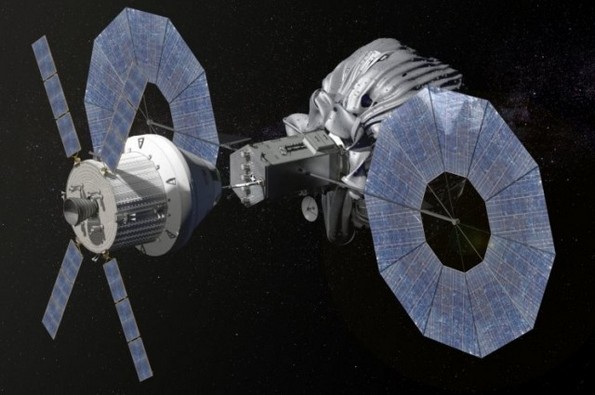
NASA plans mission to capture asteroids using a big space bag


NASA released new details on its proposed mission to divert a local asteroid into an accessible orbit today. The plan relies on a combination of already-launched proven hardware and some of the cutting edge technology still in development. The first step — picking and choosing a potential target — would be handled by the Wide Field Infrared Survey Explorer (WISE). WISE was an infrared telescope that launched in 2009 with a two-year mission to image 99% of the visible sky in infrared wavelengths. Once this mission completed successfully, NASA assigned the craft a second four-month mission to track and discover near-Earth objects (NEOs). NEOs that don’t reflect visible light, like small asteroids, can still be detected by their heat emissions.


The Russian meteorite explosion earlier this year put a new emphasis on the importance of tracking NEOs; the object that detonated in the skies above Chelyabinsk was too small to have been detected by other means. WISE has been in hibernation since the conclusion of its second mission, but was in perfect working order when NASA last communicated with the satellite in September, 2012. If all goes as planned, NASA would use WISE to find a target asteroid in an appropriate orbit.
Once that’s done, the next phase of the mission involves launching an unmanned probe to intercept the target and drag it back into a retrievable position — probably by wrapping a bag around it. While this might sound goofy (and require some hefty materials science engineering) keep in mind that we’re talking about a very modest rock. A crew would then be dispatched on an Orion capsule mated to the upcoming heavy lifter variant of the Space Launch System to retrieve samples of the asteroid and return them to Earth.


NASA’s cold fusion tech could put a nuclear reactor in every home, car, and plane


The cold fusion dream lives on: NASA is developing cheap, clean, low-energy nuclear reaction (LENR) technology that could eventually see cars, planes, and homes powered by small, safe nuclear reactors.
When we think of nuclear power, there are usually just two options: fission and fusion. Fission, which creates huge amounts of heat by splitting larger atoms into smaller atoms, is what currently powers every nuclear reactor on Earth. Fusion is the opposite, creating vast amounts of energy by fusing atoms of hydrogen together, but we’re still many years away from large-scale, commercial fusion reactors.

LENR is absolutely nothing like either fission or fusion. Where fission and fusion are underpinned by strong nuclear force, LENR harnesses power from weak nuclear force — but capturing this energy is difficult. So far, NASA’s best effort involves a nickel lattice and hydrogen ions. The hydrogen ions are sucked into the nickel lattice, and then the lattice is oscillated at a very high frequency (between 5 and 30 terahertz). This oscillation excites the nickel’s electrons, which are forced into the hydrogen ions (protons), forming slow-moving neutrons. The nickel immediately absorbs these neutrons, making it unstable. To regain its stability, the nickel strips a neutron of its electron so that it becomes a proton — a reaction that turns the nickel into copper and creates a lot of energy in the process.

The key to LENR’s cleanliness and safety seems to be the slow-moving neutrons. Whereas fission creates fast neutrons (neutrons with energies over 1 megaelectron volt), LENR utilizes neutrons with an energy below 1eV — less than a millionth of the energy of a fast neutron. Whereas fast neutrons create one hell of a mess when they collide with the nuclei of other atoms, LENR’s slow neutrons don’t generate ionizing radiation or radioactive waste. It is because of this sedate gentility that LENR lends itself very well to vehicular and at-home nuclear reactors that provide both heat and electricity.
According to NASA, 1% of the world’s nickel production could meet the world’s energy needs, at a quarter of the cost of coal. NASA also mentions, almost as an aside, that the lattice could be formed of carbon instead of nickel, with the nuclear reaction turning carbon into nitrogen. “You’re not sequestering carbon, you’re totally removing carbon from the system,” says Joseph Zawodny, a NASA scientist involved with the work on LENR.
So why don’t we have LENR reactors yet? Just like fusion, it is proving hard to build a LENR system that produces more energy than the energy required to begin the reaction. In this case, NASA says that the 5-30THz frequency required to oscillate the nickel lattice is hard to efficiently produce. As we’ve reported over the last couple of years, though, strong advances are being made in the generation and control of terahertz radiation. Other labs outside of NASA are working on cold fusion and LENR, too: “Several labs have blown up studying LENR and windows have melted,” says NASA scientist Dennis Bushnell, proving that “when the conditions are ‘right’ prodigious amounts of energy can be produced and released.”
We think it’s still fairly safe to say that the immediate future of power generation, and meeting humanity’s burgeoning energy needs, lies in fission and fusion. But who knows: With LENR, maybe there’s hope for cold fusion yet.